Policymakers, researchers and practitioners now have access to the most up-to-date rigorous evidence base on interventions addressing root causes and drivers of irregular migration, a field in which research continues to grow. The evidence base is available in our evidence gap map (EGM), first published in 2023, now updated with support from the Policy and Operations Evaluation Department (IOB) of the Netherlands Ministry of Foreign Affairs.
In this new edition, we captured the most recent impact evaluations and systematic reviews on the effects on knowledge, perceptions, intentions and migration decisions of (a) economic opportunities and decent work, (b) interventions building resilience against shocks and stressors, and (c) orderly and safe migration policies, including information campaigns. We have introduced a new intervention group: (d) external migration management, which includes migration partnerships and deals, deterrence, externalization, and remote control.
What we found
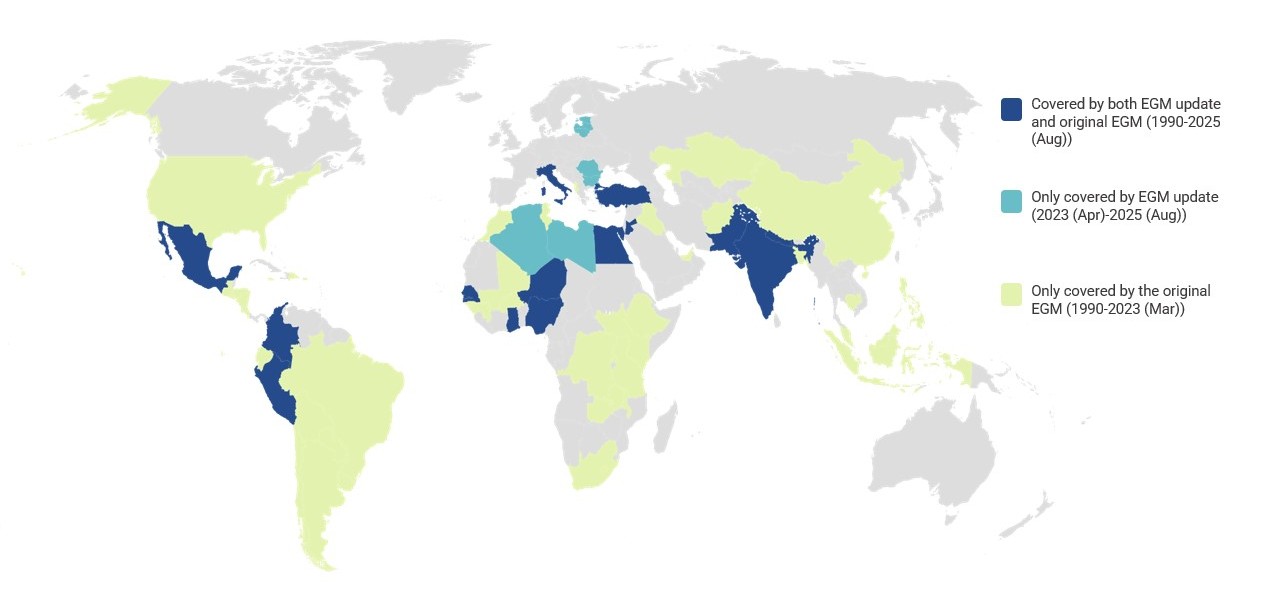
The evidence base has grown by 38% since April 2023. For our update period between April 2023 and August 2025, we added 29 new impact evaluations and one systematic review. In total, the map now features 105 impact evaluations and seven systematic reviews. Here are the key findings:
- Broader but uneven global coverage. The evidence base now spans 67 countries across the globe—which was 59 countries previously. However, most studies come from Latin America and Sub-Saharan Africa, while other regions remain underrepresented.
- In recent years, an increasing number of evaluated interventions have directly targeted (potential) migrants. While interventions not directly targeting (potential) migrants can offer valuable implications into broader contexts influencing mobility, studies of non-migration-targeted interventions can often be underpowered to detect effects on migration behavior and intentions.
- Economic opportunity programs continue to dominate the evidence base. Most do not target (potential) migrants. The largest cluster of studies on interventions targeting (potential) migrants is information campaigns. The evidence is scarce for other intervention domains.
- Migration outcomes still not well differentiated: Most studies measured broad outcomes, such as “any migration” or migration intentions, without reflecting diverse forms of migration mobility, such as unfacilitated regular migration (occurring without formal support), facilitated or assisted regular migration (through government or partner schemes), irregular migration, international displacement, and mixed forms of mobility. Only eight studies explicitly measured irregular migration behavior.
- A shift toward quasi-experimental evidence, reflecting the rise of interventions, such as migration partnerships or visa restrictions, that can be measured via quasi-experimental methods. However, qualitative impact evaluations are still largely absent from external migration management.
- On cost evidence, while some studies shared budget information, almost none assessed cost-effectiveness.
- Systematic reviews remain low-confidence due to weak search methods, limited screening procedures, no risk-of-bias assessment, or unreliable synthesis choices.
Policy implications
- Interpreting and applying existing evidence cautiously and contextually: Be careful when using intention-to-migrate data because intentions do not always match real movement; watch out for unintended effects, since interventions can work differently across places and groups.
- Ensuring migration policies are evaluable, prospective, and embedded within implementation: Plan policies in ways that allow them to be properly evaluated; build evaluation into existing migration and reintegration policies; focus new reviews and studies where evidence is growing and where important gaps remain.
- Creating an enabling environment for sustained evidence-informed decision-making: Support a culture where decisions are guided by learning and evidence; invest in a stronger migration evidence ecosystem to improve data availability, interoperability, and consistency across sources.
Research implications
- Research priorities and conceptual clarity: Focus on the biggest gaps, such as community safety and resilience interventions, well-designed development interventions that are not migration-specific can still offer valuable implications into the conditions that influence movement; include outcomes that are rarely measured, like knowledge of legal options; add migration-related measures to broader development studies; and clearly distinguish between different types of migration to make findings easier to interpret.
- Methodological rigor, cost-effectiveness and mixed-method designs: Strengthen study designs with sufficiently large sample sizes, reliable comparison groups, and full baseline and endline data; include cost-effectiveness or cost–benefit analysis; report unintended effects; and use qualitative insights to explain how and why interventions work.
- Evidence synthesis and knowledge updating: Prioritize systematic reviews in areas where many studies now exist, such as information campaigns, and use descriptive syntheses to understand emerging areas like legal pathways and external migration management; support ongoing or “living” synthesis so evidence stays up to date.
- Stronger migration evidence ecosystem: Encourage transparent reporting, data sharing, and methodological innovation; and draw lessons from other complex fields, such as trade or climate change, to better capture the wider systems that shape migration.
View the interactive EGM here, and read the update report here.
Next steps
With support from IOB and our advisory group, 3ie will produce syntheses for the following categories in the EGM framework, for which there is primary evidence but no systematic review: information campaigns, legal migration pathways, external migration management, and human capital strengthening interventions that directly target migrants. These syntheses will describe the literature and main findings where sufficient comparable studies are found, providing policymakers, practitioners, and researchers with a summary of insights from current rigorous evidence on the implementation and evaluation of these interventions. We expect to make these publicly available in March 2026.
About the project This project is commissioned by the Policy and Operations Evaluation Department (IOB) of the Ministry of Foreign Affairs of the Kingdom of the Netherlands. The partnership aims to strengthen the evidence base on interventions addressing the root causes and other drivers of irregular migration, including external migration management policies. For more information, please contact Sanghwa Lee (slee[at]3ieimpact[dot]org). |