In far too many evaluations, the end of data collection is the last time that community members hear from the research team. Research participants generally don’t find out the results of the studies they participate in, a disconnect which has been cited as an ethical issue.
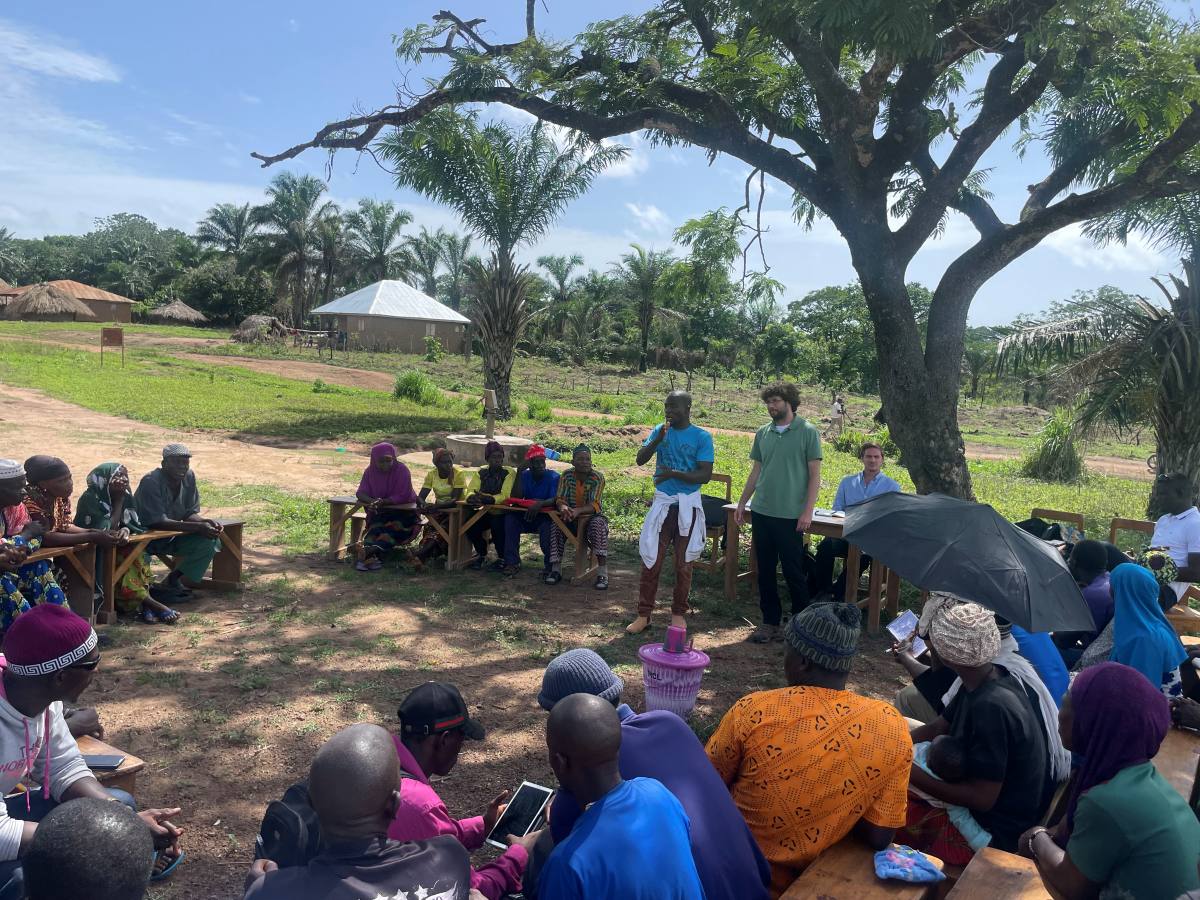
To close the loop with participants, we recently traveled to the communities in Sierra Leone and Guinea where we collected endline data in 2024. Over the course of a series of events in Sierra Leone and Guinea, we shared our preliminary findings, discussed them with community members, and learned more about the effects of the project on their lives. In addition to continuing the dialogue with individuals in these communities, the true focus of this work, these discussions also yielded new insights that will improve the quality of our impact evaluation.
The evaluation measures the effects of a cross-border project to reduce conflicts between farmers and herders with support from the United Nations Secretary-General’s Peacebuilding Fund (PBF). It is being conducted in partnership with the International Security and Development Center (ISDC). This “data return” trip was conducted jointly by the 3ie, ISDC, and the PBF.
Conducted in local languages, the events drew participants from across these diverse communities: farmers, herders, traditional authority figures, women’s leaders, and youth leaders. Events included both those who were participants in the project and those who were not, since our data collection included both implementation sites and comparison sites.
About 50 people joined each event, with many traveling from nearby communities to participate. After a brief presentation of findings by the evaluation team, the focus of the events was on the reflections of participants and a dialogue between the evaluation team and the communities. Each event ended with a communal meal for everyone, prepared in the community with local ingredients.
These communities in Northern Sierra Leone and Guinea are quite remote and difficult to access, and residents there told us that they often struggled to get current information about events in their country. These barriers to information access made our return to these communities even more important.
The project supported high-value agriculture for farmers and provided materials to fence in those crops and keep them safe from grazing cattle, provided assistance for herders, funded the construction of two new border posts between Sierra Leone and Guinea, supported local governance institutions to reduce conflict, and disseminated messages to encourage peaceful coexistence. It was implemented by the World Food Programme (WFP), the International Organization for Migration (IOM), and Talking Drum Studio (TDS).
The evaluation work was supported by Global Affairs Canada, the German Federal Foreign Office, and the PBF. The evaluation findings are expected to be published in late 2026. More information about our peacebuilding evaluations is here.