3ie has updated its 2023 Evidence Gap Map (EGM) on interventions aiming to address the root causes and drivers of irregular migration. The updated map, released in early 2026, now covers 105 impact evaluations and seven systematic reviews (published till 2025) and tells a familiar story: a growing evidence base, but one that remains uneven and fragmented, with persistent gaps across key intervention areas.
Building on that map and to make the evidence more actionable, 3ie has produced a set of evidence summaries covering four intervention areas: information campaigns, legal migration pathways, external migration management, and human capital strengthening.
These summarize the available evidence along with policy and research implications.
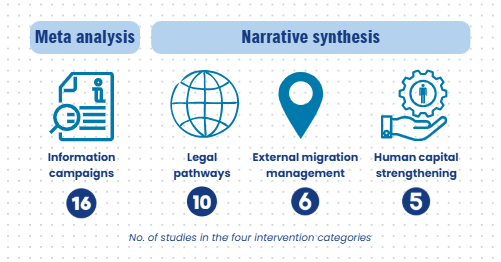
Our analytical approach varies by evidence density. For information campaigns, where studies are sufficiently comparable, the summary applies meta-analysis, pooling effect estimates across evaluations. It produces a more precise estimate of the intervention’s overall effect and reduce the risk of over-interpreting any single study.
For other areas, where evidence is thinner and more heterogenous, the summaries rely on narrative synthesis, presenting individual study findings rather than aggregating their effects. These syntheses cover intervention contexts, study design, and outcome characteristics.
Through these summaries, policymakers and researchers in these domains can gain an accessible overview of what the existing rigorous evaluations reveal about the intervention design, implementation, and effects (or the lack of them).
Our synthesis report briefly integrates both the findings from the EGM report and the evidence summaries into a single, consolidated view.
Key takeaways
 Information campaigns
- The evidence base comprises 16 impact evaluations of information campaigns on the risks of irregular migration, available regular and safer options, local opportunities, or the quality of intermediaries.
- The campaigns on the risks of irregular migration have a very small effect on intentions to migrate irregularly but there is no effect on migration behavior beyond intentions.
- The evidence base evaluating the effects of campaigns for potential migrants is emerging, with most studies using experimental designs to evaluate campaigns in North and Western Africa.
- The evidence base has key gaps: limited ability to assess differences by campaign design or target group, minimal qualitative evidence, and no cost or cost-effectiveness analysis.
 Legal pathways
- The evidence base comprises 10 impact evaluations. These interventions include formalized migration routes, such as temporary work visas and visa provisions embedded in labor and trade agreements.
- Legal pathways may generate substantial and immediate increases in regular migration flows among eligible populations by lowering legal, financial, and administrative barriers to movement. However, the interventions are likely to have varying migration impacts based on origin-destination income differentials, labor demand, conflict or crisis conditions, and migrants’ awareness of and access to these pathways.
- The evidence base gaps include limited analysis of irregular migration outcomes; sparse and inconsistent cost or value-for-money data; short exposure periods for temporary visa programs; and concentration of individual-level evidence in a small number of South–North migration corridors.
 External migration management
- The evidence base consists of six quasi-experimental evaluations, mainly assessing the EU–Turkey Statement and Italy–Libya cooperation.
- Findings suggest these policies divert migration routes, timing, or detection patterns rather than reduce overall irregular migration flows, with heterogeneous effects across migrant groups.
- Evidence gaps remain, including reliance on limited detection data, little evidence on intention-to-action dynamics, and no cost or value-for-money analysis.
- There are some evidence bas gaps which may reflect structural challenges in evaluating real-world external migration management policies.
 Human capital strengthening
- Five impact evaluations examine interventions such as unconditional cash/voucher transfers for forced migrants, health insurance for deported migrants, and vouchers for potential young economic migrants. Most studies measure migration indirectly and focus on short-term effects.
- In crisis contexts, support for basic needs and security may reduce distress-driven migration, while among deported migrants' social protection and livelihood support may lower incentives for re-migration by reducing post-return vulnerability.
- Key evidence gaps remain, including reliance on intention-based or proxy outcomes rather than actual mobility, short follow-up periods, and almost no cost or value-for-money evidence.
Policy implications
- Align the use of information campaigns with realistic outcome expectations—for example, when aiming to improve knowledge and risk awareness and support informed choice. But do not expect effects on more distal outcomes, such as migration flows.
- Embed evaluation at the design stage—this can help ensure that programs generate actionable learning, while integrating safeguards and accountability mechanisms is essential to protect the affected populations.
- Strengthen migration data ecosystems and routinely collect cost evidence—this will further support more informed, transparent, and efficient policy decisions.
Research implications
Future research in this area should:
- Test migration mechanisms and underlying decisions and causes more explicitly.
- Measure actual behaviours rather than stated intentions, and leverage policy variation to strengthen identification.
- Extend follow-up periods to be able to understand longer-term effects.
- Complement quantitative estimates with qualitative evidence to provide deeper insights into how and why interventions work across different contexts.
This project is commissioned by the Policy and Operations Evaluation Department (IOB) of the Ministry of Foreign Affairs of the Kingdom of the Netherlands. The partnership aims to strengthen the evidence base on interventions addressing the root causes and other drivers of irregular migration, including external migration management policies. For more information, please contact Sanghwa Lee (slee[at]3ieimpact[dot]org).